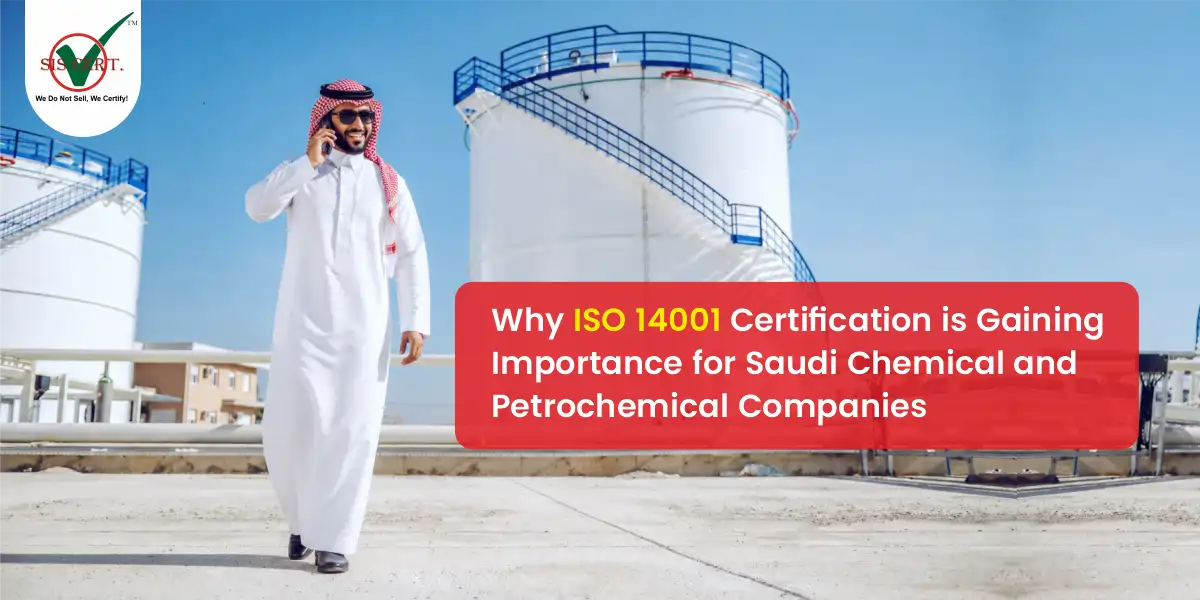
Saudi Arabia’s chemical and petrochemical industry is growing very fast. The country built its economy on crude oil exports, but today it is investing heavily in turning that oil into finished products such as chemicals, plastics, polymers, and specialty materials. Industrial cities like Jubail and Yanbu are expanding rapidly, and billions of dollars are flowing into new processing facilities every year.
Yet accountability follows expansion. With every new factory, pressures on nature increase. From Riyadh, clear steps emerge efforts like the Saudi Green Initiative aim at healing local ecosystems; toward that end, a promise exists – to balance carbon output entirely by 2060.
This point marks the role of ISO 14001 certification becoming clear. Across Saudi Arabia, an increasing number of chemical firms now follow this recognized global framework for Environmental Management Systems (EMS).
Through this article, you will learn about the significance of ISO 14001 certification for chemical and petrochemical industries in Saudi Arabia. You will see why it has become extremely important.
What Is ISO 14001 Standard?
ISO 14001 is an international standard that helps companies to manage their impact on the environment in a systematic and responsible way.
Every industrial company affects the environment in some way. For chemical and petrochemical companies, that impact is significant – hazardous materials, airborne emissions, large volumes of water, high energy consumption, and daily waste generation are simply part of how these facilities operate.
ISO 14001 is an international standard that gives companies a practical system to manage all of this — not once, but continuously. ISO 14001 changes that pattern entirely.
The standard works on a four-step cycle that is easy to understand:
- Plan – identify what environmental risks exist in your operations
- Do – put controls and procedures in place to manage those risks
- Check – measure performance and run internal audits regularly
- Act – review the results and make improvements
Then the cycle repeats. Every time it does, the company gets a little cleaner, a little more efficient, and a little better prepared for what regulators and customers expect.
Why Is ISO 14001 Becoming Important in Saudi Arabia?
Saudi Arabia is strongly focusing on sustainable industrial growth through Saudi Vision 2030. Because of this, rules on emissions, wastewater, and waste management are becoming stricter in the chemical and petrochemical sector.
Organisations which already have implemented EMS can easily adapt to these changes. They do not have to react individually to each regulation; rather, they have to adhere to their EMS in order to perform better in their environment-related tasks.
This is one of the most important reasons for the growing importance of ISO 14001 certification in chemical firms operating in Saudi Arabia. ISO 14001 certification assists businesses in achieving greater compliance, better environmental performance, and sustained business growth.
Benefits of ISO 14001 Certification for Saudi Businesses
ISO 14001 Certification is not only important for environmental compliance but also offers several long-term business advantages for chemical and petrochemical companies in Saudi Arabia.
Here is what chemical and petrochemical companies in Saudi Arabia gain:
1. Compliance without the stress
Regulations around emissions, wastewater, and waste are tightening. Companies with ISO 14001 already have systems in place — so when new rules arrive, it is a simple update, not a crisis.
2. Lower operating costs
The system tracks exactly where energy, water, and materials are being used — and where they are being wasted. Most companies see a noticeable drop in utility costs within the first year.
3. Stronger Business Reputation
People like evidence; they don’t like guarantees. ISO 14001 provides organizations with tangible and internationally recognized evidence that is self-explanatory.
4. More contracts, more markets
The growing trend is to prefer ISO 14001 certified organizations when issuing government contracts and when buying internationally. Organizations without such a certificate will not get even close to consideration.
5. Fewer surprises
Routine risk monitoring ensures that issues are identified in time before anything major happens, such as spills, shutdowns, or inspections.
6. Direct alignment with Vision 2030
The Saudi government is directing green financing and industrial incentives toward companies with genuine sustainability credentials. ISO 14001 puts companies in that category.
Key ISO 14001 Certification Requirements for Saudi Businesses
| Requirement | Purpose |
| Environmental Policy | Defines the company’s commitment to environmental responsibility and continual improvement. |
| Environmental Aspect Identification & evaluation | Helps identify activities that impact the environment, such as emissions, waste, and energy use and determine associated impacts. |
| Legal Compliance | Ensures compliance with Saudi environmental laws and regulations. |
| Environmental Objectives | Sets measurable sustainability goals and improvement targets. |
| Operational Control | Establishes procedures for waste management, pollution control, and resource efficiency. |
| Emergency Preparedness | Helps organisations prepare for spills, leaks, or environmental emergencies. |
| Monitoring & Internal Audit | Tracks environmental performance and identifies areas for improvement. |
| Management Review | Ensures senior management regularly reviews and improves the EMS. |
Addressing Common Concerns
Many companies worry that ISO 14001 certification is too expensive, too complicated, or takes too long. This is a common concern, but not the full picture.
The other thing that makes a real difference is mindset. Companies that treat ISO 14001 as just another documentation task find it harder. Companies that treat it as a system to genuinely improve their operations find it faster, cheaper, and far more valuable.
Done right, ISO 14001 improves environmental performance, reduces operational costs, and builds a stronger, more sustainable business — not just a certificate on the wall.
The Right Time to Act Is Now
The demand for stronger environmental practices is increasing across Saudi Arabia’s chemical and petrochemical sector. With increasing environmental regulations and rising sustainability standards among other nations in the world, ISO 14001 Certification in Saudi Arabia is gradually turning into an absolute necessity for any business.
Building a solid Environmental Management System, training their teams, and tightening environmental controls now means they are ready not rushing, when new regulations arrive or new market opportunities open up.
ISO 14001 is not a certificate you frame and forget. It works quietly in the background every single day improving how a facility runs, reducing what gets wasted, and keeping the business aligned with where Saudi Arabia is heading.
Final Thoughts
Saudi Arabia is moving fast toward its Vision 2030 goals and the chemical and petrochemical sector is right at the centre of that journey. For companies ISO 14001 is no longer a future consideration. It is a present-day business decision that affects compliance, market access, operational efficiency, and stakeholder trust all at once.
The companies that will lead this sector are not the ones that wait for regulations to force their hand. They are the ones building stronger systems, training better teams, and making environmental responsibility part of how they do business every day.
SIS Certifications works alongside chemical and petrochemical companies across Saudi Arabia, guiding them through every stage of ISO 14001 implementation, from the first gap analysis to the final certification audit.