
India aims to become a trillion-dollar digital economy, characterized by platforms, data, AI, fintech, e-commerce, and health tech. India seeks to scale rapidly by focusing on innovation and expanding globally, with a particular emphasis on data privacy and information security.
However, the truth is that a digital economy without data protection is just growth on borrowed trust.
That’s where the Digital Personal Data Protection (DPDP) Act comes in, not as red tape but as bureaucracy. The Digital Personal Data Protection (DPDP) Act serves as the legal foundation that makes India’s digital vision credible and internationally recognized.
Incidents that create a demand for drafting the Digital Personal Data Protection (DPDP) Act.
The Wake-Up Call: Aadhaar Data Leaks
Aadhaar was intended to streamline welfare delivery, while also providing a reliable identity proof for citizens. What it exposed instead was how casually personal data was being handled.
Investigations revealed that Aadhaar details, such as names, addresses, and linked identifiers, were being accessed and sold for the price of a movie ticket. It had no meaningful penalties, with no clear accountability or strong law.
India was collecting data at a population scale without population-scale protection, and that’s not how a serious digital economy operates.
source – https://www.huntress.com/threat-library/data-breach/aadhaar-data-breach
Privacy Became a Fundamental Right
- Data collection must be justified.
- Data use must be proportionate.
- Data protection must be enforceable.
Cambridge Analytica: When Indian Data Reached Global Without Consent
The Cambridge Analytica scandal revealed how personal data could be harvested, analyzed, and weaponized.
Millions of Indian users were affected. However, political profiling took place, and proved consent was a joke.
And India had no clear legal framework to:
- Hold platforms accountable
- Penalise misuse
- Protect citizens’ digital rights.
Indian data was valuable enough to exploit but not protected enough to defend.
Source of information – https://timesofindia.indiatimes.com/india/cambridge-analytica-may-have-accessed-5-6-lakh-indians-data-facebook/articleshow/63636221.cms
Data Breaches Became Normal
Data breaches have become normal, whether you name Banks, telecom companies, fintech apps, healthcare platforms, or airlines.
Breaches happened not once, twice, but repeatedly.
What didn’t happen?
- Mandatory breach disclosures
- Serious financial penalties
- User compensation
When negligence is cheap, compliance doesn’t happen. The DPDP Act changes that cost equation decisively.
Global Trust Is Non-Negotiable in a Digital Economy
If India wants to lead in:
- IT & ITES
- SaaS exports
- Cross-border data services
- Global partnerships
Then it must speak the language of data trust.
Countries with GDPR-style regimes don’t gamble with jurisdictions that lack enforceable data protection laws.
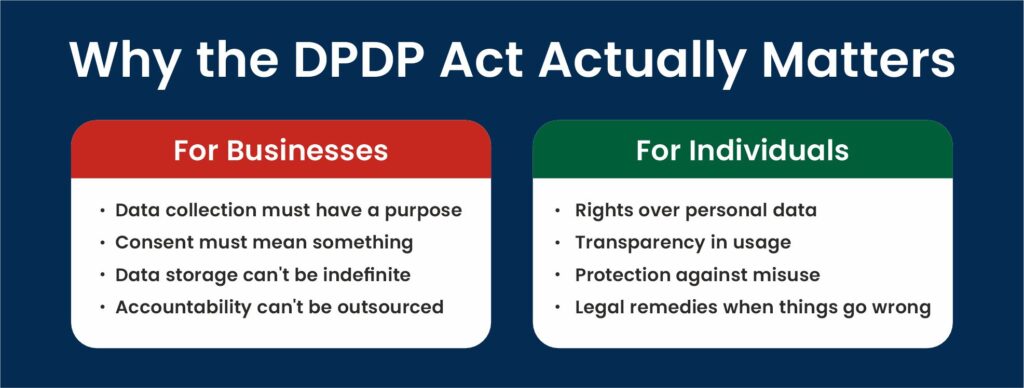
Why the DPDP Act Actually Matters?
Conclusion
The DPDP Act wasn’t born from foresight alone. It was born from data leaks, court intervention, global embarrassment, and economic pressure.
A trillion-dollar digital economy cannot run on weak data governance. Trust is infrastructure, and privacy is economic capital.
For businesses, the choice is to build compliance into growth and explain negligence later to regulators, customers, and global partners.
In the Indian digital market, trust will decide who scales and who stalls.
How SIS Certifications Supports DPDP Act Success
DPDP Act compliance is mandatory for organisations managing personal data in India’s growing digital economy. It requires clear consent for responsible data use and secure storage. SIS Certifications provides comprehensive support for DPDP readiness, from scoping and gap assessments to remediation planning and internal reviews. As a result, this structured approach enhances data trust and positions businesses for secure, sustainable growth.